Showing posts with label bbq. Show all posts

Saturday, 19 March 2011

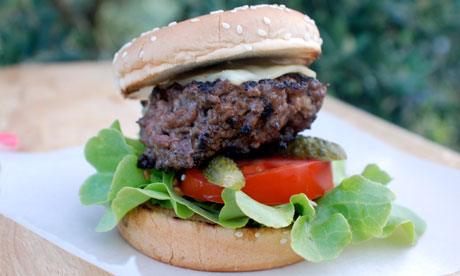
The Perfect Burger


Ingredients (Serves 6)


    1 tbsp oil or butter
    1 large onion, finely chopped
    1kg roughly minced chuck steak (or any non-lean mince)
    100ml stout
    2 tbsp brown breadcrumbs
    2 tsp chopped herbs (parsley or thyme work well)
    1 tsp salt
    Black pepper
    Garnishes, sauces and rolls, as desired


Heat the oil in a frying pan over a low heat, and cook the onion until soft and slightly browned. Leave to cool.

Spread the beef out and sprinkle over the onion. Add the stout, breadcrumbs, herbs and seasoning and mix together with a fork, being careful not to overwork it.

Divide the meat into 12 flattish burgers, putting a dimple in the centre of each. Cover and refrigerate for an hour.

Cook the burgers on a medium to hot barbecue or griddle pan: leave them undisturbed for the first 3 minutes so they build up a good seal on the bottom, then carefully turn them over, adding a slice of cheese on top if desired. Cook for a further 4 minutes for rare, and 7 for well done, and allow to rest for a few minutes before serving. (You can toast buns, cut-side down, on the barbecue at this point.)

What goes into your perfect hamburger – and what goes on top? Is beef still best for burgers, and where serves the finest in the world?
Tuesday, 31 August 2010

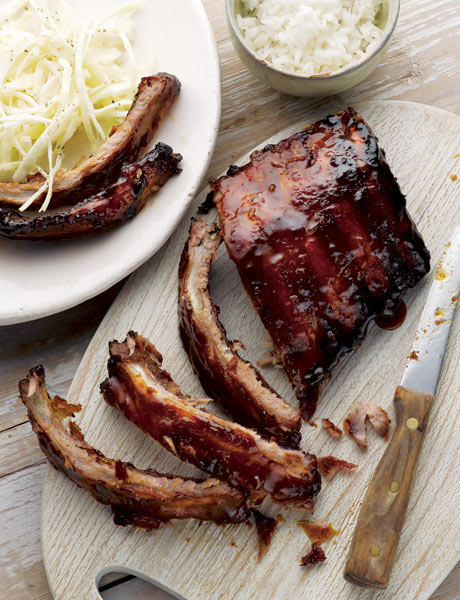
Sticky five-spice Ribs


Ingredients (Serves four)

    2kg rack pork back ribs
    4 garlic cloves, crushed
    2 tbsp freshly grated root ginger
    125ml soy sauce
    125ml hoisin sauce
    60ml honey
    1 tsp five-spice powder
    2 tbsp mild-flavoured oil, such as sunflower
    For the cabbage salad
    ¼ cabbage, cored
    2 tbsp white-wine vinegar
    A few drops sesame oil
    Sea salt
    ½ tsp sugar
    To serve
    Steamed rice

Put the ribs in a baking dish. Place all the remaining rib ingredients in a food processor and pulse until smooth (or simply stir together in a bowl). Pour all but a few tablespoons of this marinade over the ribs and rub well in. Turn the ribs meat-side down, ready for cooking.

Heat the oven to 200C/400F/gas mark 6. Bake the ribs for 40 minutes, then turn them over and brush with the reserved marinade. Raise the heat to 220C/425F/gas mark 7, and cook for 10 minutes more.

Meanwhile, shred the cabbage and place in a bowl. Combine the vinegar, sesame oil, salt and sugar to make a dressing, drizzle over the cabbage and toss with your hands.

Lift the ribs on to a board and cut each rib off the rack. Serve with the cabbage salad and steamed rice.

Sunday, 29 August 2010

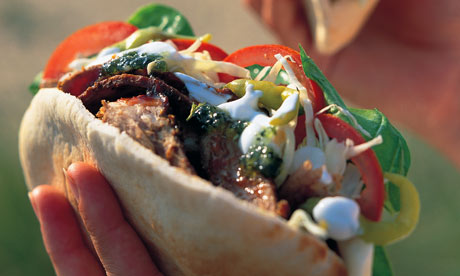
Lamb shwarma kebab with spinach, red onion, peppers, sweet chilli sauce, garlic sauce and pickled green chillies

Ingredients (Makes six)


    700g trimmed neck fillet
    For the marinade
    3 tsp coriander seeds
    3 tsp cumin seeds
    2 tsp mild paprika
    1½ tbs pomegranate molasses
    ¼ tsp freshly ground black pepper
    1½ tbs olive oil
    For grilling the lamb
    fine sea salt
    To assemble the kebabs
    150g white cabbage, finely sliced
    75g baby spinach leaves
    ½ red onion, finely sliced
    juice of 1 lemon
    6 pitta breads
    3 medium-sized tomatoes, sliced into rounds
    8 pickled green chillies, or to taste
    To serve
    Garlic sauce
    sweet chilli sauce


To marinate the meat


Toast the coriander and cumin seeds over the heat in a dry skillet or frying pan, and grind. Mix in a bowl with the other marinade ingredients. Using disposable gloves, rub the lamb all over with the marinade. Cover and refrigerate overnight or for at least 3 hours.

To grill the lamb


Before barbecuing, give the lamb enough time out of the fridge to lose its chill. This cut of lamb has a relatively high fat and weak sinew content, so needs slow cooking. Season the lamb well with salt. Before you begin barbecuing, have all your kebab ingredients lined up and ready to go.

Barbecue


Preheat the grill to medium-high or 'sizzle' temperature. Clean and lightly oil the rack. A clean grill is particularly important for this recipe, as the pomegranate molasses can make the lamb stick. Place the lamb on the grill and seal on all sides. This should take about 2-3 minutes. Move to a medium heat and cook for a further 12-15 minutes, or until cooked through, turning every 3 minutes or so. Remove the lamb to a warmed tray. Cover and leave to rest for 3-4 minutes while you organise yourself to assemble the kebabs.

To assemble the kebabs


Toss the cabbage, spinach and red onion with the lemon juice and season to taste. Slice the lamb thinly on the diagonal, across the grain of the meat, to give doner-kebab-like strips. Warm the pitta breads on the barbecue for a minute on each side until they puff up and are easy to split. Don't toast them, as they will become inflexible. Split the bread down one side. Divide the dressed cabbage and spinach mix between the pittas and top with the tomato and chilli, finishing with the garlic sauce and the sweet chilli sauce.

Thursday, 12 August 2010

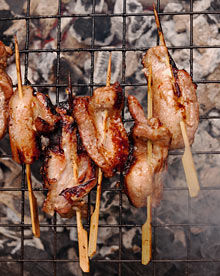
Five-spice grilled pork belly


Almost any cut will work. As would a small pork steak or chop.

Ingredients (makes 20 skewers)


    750g pork belly
    For the marinade:
    3 cloves garlic
    1 thumb-sized lump ginger
    2 tbsp light soy sauce
    3 tbsp rice wine
    1 lightly heaped tsp five-spice powder
    1 tsp salt
    2 tbsp runny honey
    20 flat, strong wooden skewers


Put the pork on a chopping board and slice in half lengthways, then cut each half into thin strips no thicker than 2cm. Put the pieces of meat into a dish or roasting tin.

Peel and finely crush the garlic using a pestle and mortar. Peel and finely grate the ginger into the garlic. Stir in the soy sauce, rice wine, five-spice, salt and honey. Tip this marinade over the pork and toss gently to lightly coat the meat. Set aside for a good hour, though a couple more (or overnight) would be better. Soak the skewers for an hour or more in cold water.

Thread each piece of meat on to a skewer. Get the grill hot. When the charcoal is grey and there are no longer flames or vividly glowing coals, lay the skewers on the bars of the grill. Leave until the underside is golden brown (the timing will depend on the thickness of your pork and the heat of your charcoal, but you should reckon on about 8-10 minutes), then turn and cook the other side.

When the pork is cooked through and the fat deep golden, remove and serve.

Thursday, 5 August 2010

How to make the best beef burger


The hamburger may well have European origins, but it took the Americans to see the potential of this "companionable and faintly erotic" chunk of seasoned beef as comfort food extraordinaire: the personification of "the Great Mother herself … the nipple of the Goddess, the bountiful belly-ball of Eve" as Tom Robbins so neatly puts it. Because even if you tuck into seven colours of caviar every weekend, I bet the scent of grilling burgers still gets you all Pavlov's dog around the chops. It's that primal, charred, slightly crunchy exterior, the soft, juiciness within - and of course, that perfect combination of toppings, chosen in childhood and sacred ever after.

Burgers may be fast food, but they're also a craft. There are clubs devoted to the cult of the perfect patty, endless articles devoted to the 20 examples you must "try before you die" (if they don't finish you off first), and every month, a new, and usually outlandish variation on the theme, from 10oz hunks of foie gras to doughnut buns. But I'm interested in taking the burger back to basics, with a classic beef number suitable for cooking on the barbecue, or a hot griddle pan.

The beef


After a little experimentation, I realised that there is no place for lean, or finely ground beef in a burger - both produce a dry, crumbly patty unworthy of the name. "Top chef" John Torode, who's so keen on beef that he's written a book about it, reckons that the "best formula will be something like 40 per cent fat – yes, truly that much! – otherwise it will not be moist."

Although you'll probably struggle to find that high a fat content, avoid anything marked as lean, prime steak cuts like rump; Heston recommends a 2:1:1 combination of chuck, short-rib and brisket, but in my experience, plain old chuck will do nicely. Ideally of course, you would mince your beef yourself, but, if you have neither the time, nor the appropriate food processor attachment, then ask your butcher to do it for you - a coarse mince gives the best texture.

The pure burger


In its simplest form, the burger is nothing but minced beef and seasoning. Leiths Meat Bible, a book devoted to the cult of the carnivore, is of this school, although it does allow for some optional chopped onion and herbs. I mix 675g of chuck mince with a finely chopped onion, a little thyme and some salt and pepper, shape them into burgers, and chill before popping them on a hot barbecue.

As someone who habitually adds egg as a binding ingredient, I'm surprised at how well these hold together on the grill. Although cooked medium rare, however, the interior is still a little chewy. A solid effort, with a nice beefy flavour, but there's room for improvement.

Egg


The next recipe I try comes from Larousse Gastronomique. Their entry on one of the world's finest foodstuffs is snottily Gallic in its brevity, but they do condescend to share their formula, which includes 400g minced beef, 50g chopped onion, 1 tsp chopped parsley, and 2 eggs. They make the mixture a bit sloppy, but once the burgers have chilled, they hold together nicely. Cooked, however, they're a definite disappointment: the egg has made them dry and fibrous, although, as one of my crack burger tasting panel notes generously, it has given them a deliciously crunchy exterior.

Egg and breadcrumbs


My own recipe contains less egg (1 medium example to 500g minced beef) but does include about 60g breadcrumbs - brown for preference - along with a small onion, softened in butter, a sprinkling of chopped thyme, and salt and pepper. More loosely packed than the first two, these are more difficult to keep together on the grill, but once cooked, they seem less dense, and juicier, with the bread adding an extra layer of malty flavour. The cooked onion gives them a hint of sweetness as well.

Cream


After the disaster with Larousse recipe, I'm beginning to wonder whether egg is necessary after all. In his excellent barbecue book, Food from Fire, Charles Campion gives a recipe for hamburgers which contain 1 tbsp double cream for every 500g meat, which, he says, will make burgers "juicy and delicious". The results are indeed tasty, but also rather rich, even with this infinitesimal amount of cream - "they need pickles to cut through the fattiness", opines one sage, reaching for the gherkin jar.

Guinness


Campion also gives an "implausible" recipe for Guinness hamburgers, which contains 50ml Irish stout to every 500g beef. "There is something about the chemical interactions of fizzy liquid and the protein in lean meat that helps bind everything together," he says. "The faint bitterness of the stout also helps tenderise the meat and balance the flavours." After an hour maturing in the fridge, these oddly brown burgers go on the grill. They prove slightly crumbly when cooking, but they're well worth it - the meat is meltingly tender, and the malty flavour of the Guinness really brings out its savoury beefiness.

Water


Adam Perry Lang, a former Grand Champion at the Jack Daniel's World Championship Invitational Barbecue in Tennessee, has plainer tastes. He mixes 225ml of cold water into 1.1kg minced beef, seasons, and cooks. (Fried onions, apparently, are strictly for toppings.) Massaging water into meat feels distinctly bizarre, and I have to resist the temptation to wring the patties out like a sponge. The results are undeniably juicy, but the water has neither the tenderising, nor the flavour-enhancing qualities of the Guinness.

Technique


Leiths Meat Bible suggests I make a dimple in my burgers to keep them flat during cooking - it certainly helps to avoid the slightly unappetising cannon-ball effect I usually end up with. Most recipes caution against overworking the mixture, which can make the meat tough: shape it into patties firm enough to hold together, but don't be tempted to squeeze them, or squash them against the grill like you're in an American diner - you'll just end up with a dry burger.

The perfect burger is a very personal matter - the herbs, the seasoning and the garnish are all down to you, but for tender meat, and an intensely savoury flavour, you can't beat a slug of stout in your mixture.

The perfect burger


Ingregients (serves 6)


    1 tbsp oil or butter
    1 large onion, finely chopped
    1kg roughly minced chuck steak (or any non-lean mince)
    100ml stout
    2 tbsp brown breadcrumbs
    2 tsp chopped herbs (parsley or thyme work well)
    1 tsp salt
    Black pepper
    Garnishes, sauces and rolls, as desired

  1. Heat the oil in a frying pan over a low heat, and cook the onion until soft and slightly browned. Leave to cool.
  2. Spread the beef out and sprinkle over the onion. Add the stout, breadcrumbs, herbs and seasoning and mix together with a fork, being careful not to overwork it.
  3. Divide the meat into 12 flattish burgers, putting a dimple in the centre of each. Cover and refrigerate for an hour.
  4. Cook the burgers on a medium to hot barbecue or griddle pan: leave them undisturbed for the first 3 minutes so they build up a good seal on the bottom, then carefully turn them over, adding a slice of cheese on top if desired. Cook for a further 4 minutes for rare, and 7 for well done, and allow to rest for a few minutes before serving. (You can toast buns, cut-side down, on the barbecue at this point.)

What goes into your perfect hamburger – and what goes on top? Is beef still best for burgers, and where serves the finest in the world?
Friday, 30 July 2010

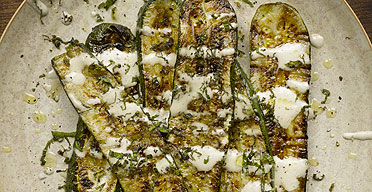
Grilled courgettes with tahini dressing & home-made flatbreads


This dish is great as it is, or served as an easy side dish with barbecued lamb chops, say, or, best of all, wrapped in the flatbread recipe that follows.

Ingredients

(serves four)
55ml tahini
55ml water
Juice of ½ lemon
1 clove garlic, grated
Sea salt
450g courgettes, sliced 1cm thick lengthwise
3 tbsp olive or rapeseed oil, plus more for drizzling
Freshly ground black pepper
3 tbsp fresh mint leaves, shredded

For the flatbreads
    250g plain flour, plus extra for dusting
    250g strong white bread flour
    5g easy-blend yeast
    10g salt
    1 tbsp good-quality olive oil (plus extra for glazing; optional)
    325ml hot water, or an equal mixture of hot water and natural yogurt
    For the glaze (optional)
    ½ tsp cumin seeds
    ½ tsp coriander seeds
    20g unsalted butter
    2 tbsp olive oil
    A good pinch of smoked paprika

the courgettes


First make the dressing, which is a cinch - just whisk together the tahini, water, lemon juice, garlic and a pinch of salt, then set aside.

Brush the courgettes with oil, sprinkle with a little salt and grill over medium coals until lightly charred and tender - about four minutes on each side.

Arrange the courgettes on a plate, drizzle over some of the tahini dressing and a splash or two of oil, a few grinds of pepper, some salt flakes and a sprinkling of mint. Serve immediately.

the flatbreads


These breads, which were devised by Dan Stevens, one of the chefs at River Cottage, are perfect with grilled food, with or without the spicy glaze.

If you want to make a glaze for your flatbreads, start with that; otherwise, skip this and go straight to the next paragraph. Heat a small frying pan over a medium heat, and when hot toast the cumin and coriander seeds for a minute or so until they release their fragrance. Grind with a pestle and mortar. Melt the butter, whisk in the olive oil, the ground cumin and coriander, and the paprika. Brush the glaze over the breads just before putting them on the grill, or do so just after they come off the grill - both approaches work well.

To make the flatbreads, mix all of the dry ingredients in a bowl and make a well in the centre. Tip the water (or the yogurt/water mix) into this well, pour in the olive oil, and mix together. Knead the dough until smooth, silky and elastic, then brush it with oil, cover and leave to rise until doubled in size. Deflate the dough, then leave to rise a second time, again until almost doubled in size.

Tear off pieces of dough the size of small lemons. Using plenty of flour on both your hands and the worksurface, shape them into rounds and roll out to 3-4mm thick. Leave each one to rest for five minutes or so.

Brush the flatbreads with the seasoned butter glaze or olive oil (both optional), then cook over a hot barbecue for four to five minutes, turning once, until puffed up and just beginning to char. Serve at once.


Original post